


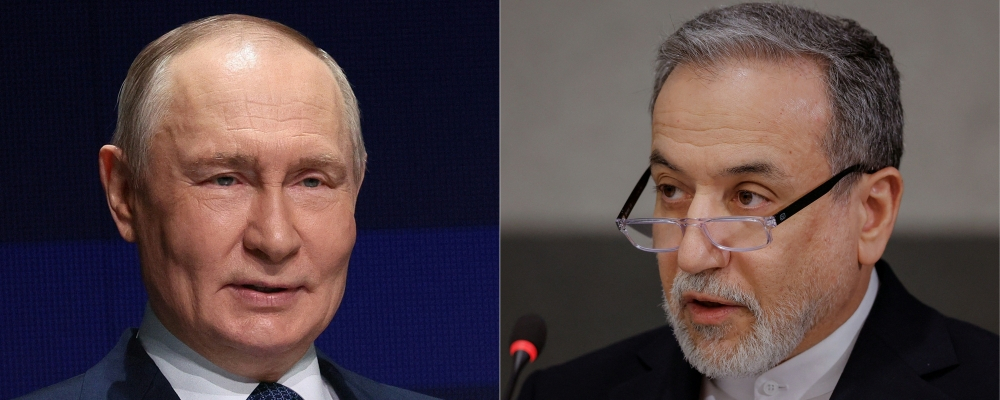
Putin meets Araghchi in Moscow as US–Iran peace efforts hang in uncertainty
Tensions and diplomacy are moving side by side as Iran’s Foreign Minister Abbas Araghchi arrived in Saint Petersburg on Monday for high-level talks with Russian President Vladimir Putin. The visit comes at a critical moment, with fragile peace efforts between Iran and the United States facing new setbacks.
Araghchi’s trip to Russia follows a wave of diplomatic movements across the region. He had earlier visited Oman and Islamabad, where mediators have been trying to keep communication open between Tehran and Washington.
However, momentum slowed after US President Donald Trump cancelled a planned visit to Pakistan by his envoys, Steve Witkoff and Jared Kushner. The cancellation raised fresh doubts about whether talks could move forward.
Despite the setback, behind-the-scenes communication appears to be ongoing. Iranian sources revealed that Tehran has sent written messages to the US through Pakistan, outlining its “red lines”—especially on nuclear matters and control of the Strait of Hormuz. While these messages are not part of formal negotiations, they signal that dialogue hasn’t completely collapsed.
There are also reports suggesting Iran may have floated a proposal focused on reopening the Strait of Hormuz and ending current hostilities, while delaying nuclear discussions to a later stage. Although not officially confirmed, the possibility has added another layer of complexity to an already tense situation.
Even though a ceasefire in the US-Israel conflict involving Iran is holding for now, the global impact is being felt. Iran’s decision to block the Strait of Hormuz—a crucial route for oil, gas, and fertiliser—has disrupted global supply chains. Prices have surged, and concerns are growing over food security, particularly in developing countries. Meanwhile, the United States has responded with its own blockade measures.
The political pressure is also building in Washington. Rising fuel prices are affecting American households, and with midterm elections approaching, Trump faces increasing scrutiny at home. Public opinion polls indicate that the ongoing conflict is not widely supported.
Meanwhile, regional tensions remain high. In Lebanon, clashes between Israel and Hezbollah continue despite a recently agreed ceasefire. Israeli Prime Minister Benjamin Netanyahu accused Hezbollah of violating the agreement, while Hezbollah blamed Israel for ongoing aggression.
Airstrikes in southern Lebanon have reportedly caused civilian casualties, including women and children, further intensifying the humanitarian crisis. Both sides claim they are acting in response to threats, keeping the region on edge.
At the heart of all this, Araghchi’s diplomatic push signals that Iran is still prioritising regional stability—but not at the cost of its strategic interests. Russia’s involvement adds another powerful dimension, suggesting that global alliances are continuing to shape the direction of this conflict.