


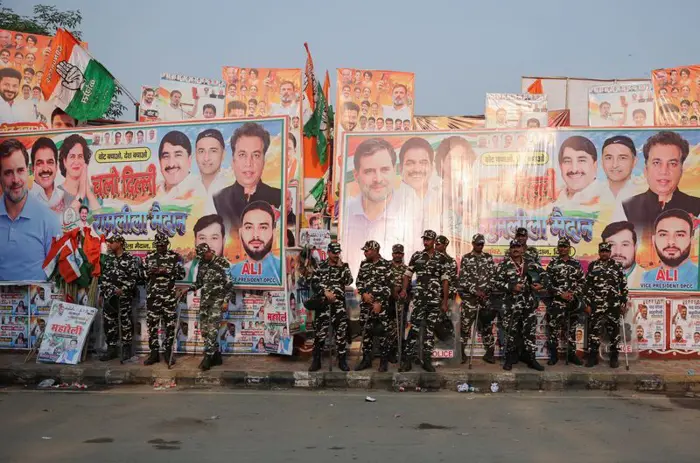
Indian authorities tighten security ahead of big opposition march in Delhi
Indian authorities have stepped up security across parts of New Delhi ahead of a major opposition march scheduled for Sunday, as political tensions continue to rise over controversial changes to the country’s voter lists.
Security personnel equipped with batons and shields, along with riot-control vehicles, were deployed around Ramlila Maidan, the designated venue for the protest rally. The demonstration is expected to draw a large crowd and will be led by senior Congress leader Rahul Gandhi.
The opposition is demanding the resignation of Chief Election Commissioner Gyanesh Kumar, accusing the Election Commission of overseeing voter list revisions that could unfairly disadvantage opposition supporters and minority communities. Opposition leaders have described the planned demonstration as a significant challenge to Prime Minister Narendra Modi’s government and the ruling Bharatiya Janata Party (BJP).
Several opposition parties, student organisations and the youth-led Cockroach Janta Party have reportedly organised almost daily demonstrations since last month. Their central demand is greater accountability and transparency in the electoral process.
However, the Election Commission has rejected allegations of political favouritism, maintaining that the voter list revision was conducted through legitimate procedures. It has also stated that individuals whose names were incorrectly removed can apply to have their registrations restored. The BJP, meanwhile, has accused opposition parties of attempting to undermine public confidence in democratic institutions.
According to the opposition, Sunday’s demonstration will include a march covering approximately 1.5 kilometres from Central Delhi to Ramlila Maidan, where a major public rally is planned.
News agency ANI reported that dozens of security personnel and riot-control vehicles were stationed outside the protest venue. Public announcements were also being made, asking participants to cooperate with police officers and avoid disrupting traffic.
Delhi Traffic Police warned residents and commuters to expect congestion, traffic restrictions and possible diversions because of the anticipated large gathering.
Speaking to ANI, senior police officer Rohit Rajbir said arrangements had been made at the rally venue and along the planned march route to manage the crowd and maintain public order.
The controversy surrounding the voter list revision intensified following a September report by The Indian Express. The newspaper reported that two deputy election officials had raised internal concerns about voter list changes, registration procedures and the digital systems involved in the process.
The revision, which began last year, reportedly resulted in the removal of more than 130 million names from voter lists. The figure includes approximately 28 million deceased individuals, 63 million people who had relocated and 30 million whose whereabouts could not be established. The total number is larger than Japan’s population.
Opposition parties have raised particular concerns about the potential impact on Muslim voters and other minority communities, alleging that the deletions could disproportionately affect groups less likely to support the ruling Hindu nationalist party. Both the Election Commission and the BJP have rejected these accusations.
Political analysts have described the growing demonstrations and increasing opposition mobilisation as a significant challenge for Modi since he first became prime minister in 2014. Nevertheless, his government remains in power, with India’s next general election not scheduled until 2029.
As preparations continue for Sunday’s demonstration, the situation highlights the growing public debate over electoral transparency, political accountability and confidence in India’s democratic institutions.
Ultimately, the issue extends beyond one political march or a demand for one official’s resignation. For millions of voters, the bigger concern is whether every eligible citizen can exercise their right to vote and whether the electoral system can maintain public trust. How authorities address these concerns could have lasting implications for India’s political environment.