


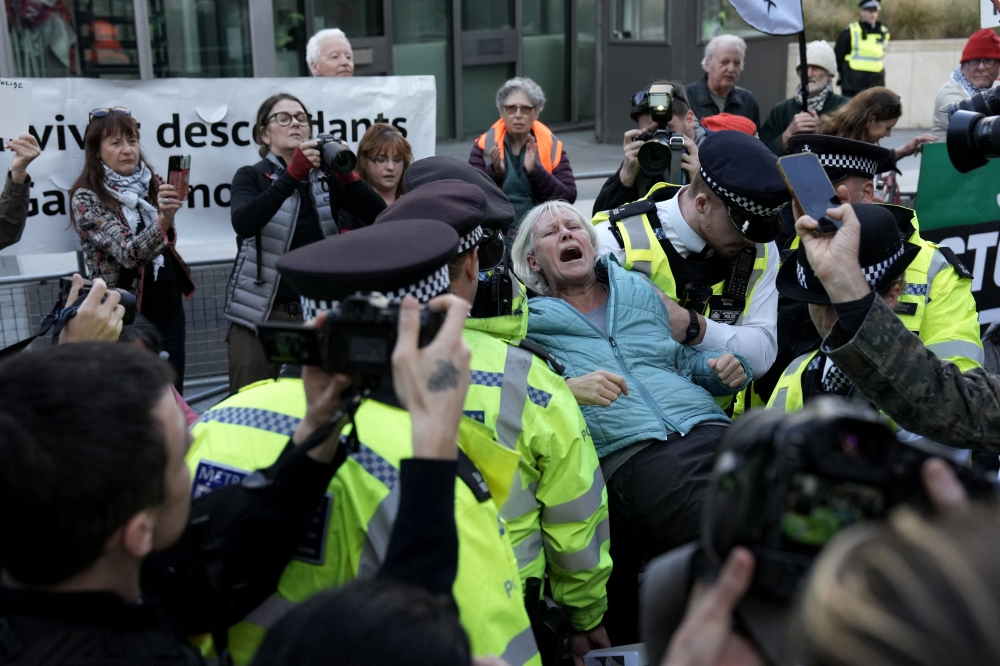
‘We are protesters, not terrorists’ 139 arrested at London rally over Palestine Action ban
British police arrested at least 139 supporters of Palestine Action during protests in London and Edinburgh, as tensions surrounding the government’s ban on the group continue to grow ahead of a major court hearing.
The arrests took place during demonstrations organised in opposition to the government’s decision to classify Palestine Action as a proscribed organisation under anti-terrorism legislation. In London, hundreds of protesters gathered outside the US Embassy for a lunchtime demonstration, where police began making arrests shortly after the gathering started.
London’s Metropolitan Police confirmed in an evening update that 139 people had been detained, adding that officers were continuing to make arrests.
The latest demonstrations come amid a wider wave of arrests since the British government outlawed Palestine Action in July 2025. Campaigners say more than 4,000 people have been arrested on suspicion of expressing support for the organisation.
Many demonstrators, including elderly citizens and Holocaust survivors, have reportedly taken part in peaceful vigils carrying signs that read, “I oppose genocide. I support Palestine Action.”
The situation has sparked serious questions about freedom of expression, the right to peaceful protest and the limits of anti-terrorism legislation. According to protest organisers Defend Our Juries, the number of arrests linked to peaceful demonstrations reflects an increasingly troubling situation.
The organisation described the arrests as deeply concerning, arguing that using terrorism legislation against peaceful protesters raises important questions about civil liberties in Britain.
The ban places Palestine Action on the government’s list of proscribed organisations, alongside groups including Hamas and Hezbollah. Under the legislation, membership of or support for Palestine Action can carry a prison sentence of up to 14 years.
Supreme Court challenge puts government ban under scrutiny
The legal battle surrounding the ban is now approaching a significant moment.
Palestine Action co-founder Huda Ammori has challenged the government’s decision, arguing that the prohibition is disproportionate and infringes fundamental human rights.
The case is scheduled for a two-day Supreme Court hearing beginning Wednesday. The hearing follows a June ruling by the Court of Appeal that supported the government’s position.
The outcome could have important consequences for the future of Palestine Action, the rights of protesters and the broader debate over how governments use anti-terrorism powers.
In July, hearings involving more than 2,000 people arrested in connection with the issue were postponed until later this year, adding to the uncertainty surrounding the cases.
Protesters say they are defending the right to speak out
At the London demonstration, protesters carried banners expressing opposition to the arrests and the government’s decision to ban the organisation.
Messages included, “How is trying to stop a genocide a crime?” and “We are protesters, not terrorists.”
Among those attending was 75-year-old activist Angie Zelter, who told AFP that she had previously been charged at least eight times following earlier demonstrations. Despite those experiences, she returned to protest ahead of the Supreme Court hearing.
She said she hoped the courts would reconsider the decision to proscribe Palestine Action.
Another demonstrator, 70-year-old retired financial adviser Marji Mansfield, said she had been arrested approximately ten times at previous rallies.
She expressed growing disappointment with the judicial system, while suggesting that reversing the ban could offer the government an opportunity to resolve the growing controversy.
However, she acknowledged that there was currently little indication that the government would change its position.
Authors and publishers also caught up in the controversy
The debate has extended beyond demonstrations and courtrooms, reaching the publishing industry.
Irish bestselling author Sally Rooney has become part of the controversy because of her support for Palestine Action.
Her publisher, Faber, recently revealed that it could no longer sell her books in the United Kingdom because of her position on the organisation.
The development has raised further questions about the wider consequences of the ban, particularly its potential impact on individuals and organisations expressing support for the group.
Why Palestine Action became a major political issue
Founded in 2020, Palestine Action has described its mission as opposing international involvement in what it calls Israel’s system of occupation, apartheid and genocide.
The organisation became more widely known following Israel’s military offensive in Gaza after the October 7, 2023 attacks in southern Israel by Hamas-led fighters.
Its activities in Britain have primarily focused on weapons manufacturers, particularly facilities associated with Israeli defence company Elbit Systems.
The government’s decision to proscribe the organisation under terrorism legislation has since become the subject of intense political, legal and public debate.
A growing debate over protest, freedom and civil liberties
The latest arrests highlight a difficult question facing Britain: how should a democratic government balance national security legislation with the public’s right to protest and express political opinions?
For campaigners, the issue goes beyond one organisation. They argue that the ability to peacefully demonstrate, challenge government decisions and express opposition to international conflicts is fundamental to democratic society.
For the government, the prohibition reflects its position on the organisation and the need to apply national security laws.
As the Supreme Court prepares to examine the legal challenge, attention will turn to whether the ban can withstand scrutiny under British law.
Whatever the outcome, the case is likely to remain an important moment in Britain’s ongoing discussion about freedom of expression, public protest, human rights and the boundaries of anti-terrorism legislation.
The central question is no longer limited to the future of Palestine Action. It also concerns how far the right to peaceful political expression can extend in a democratic country.