


Pezeshkian Calls for Closer Iran-Russia Cooperation
Iranian President Masoud Pezeshkian has called for faster implementation of agreements between Tehran and Moscow, urging both countries to turn diplomatic commitments into concrete results through expanded cooperation in energy, transportation, trade and electricity generation.
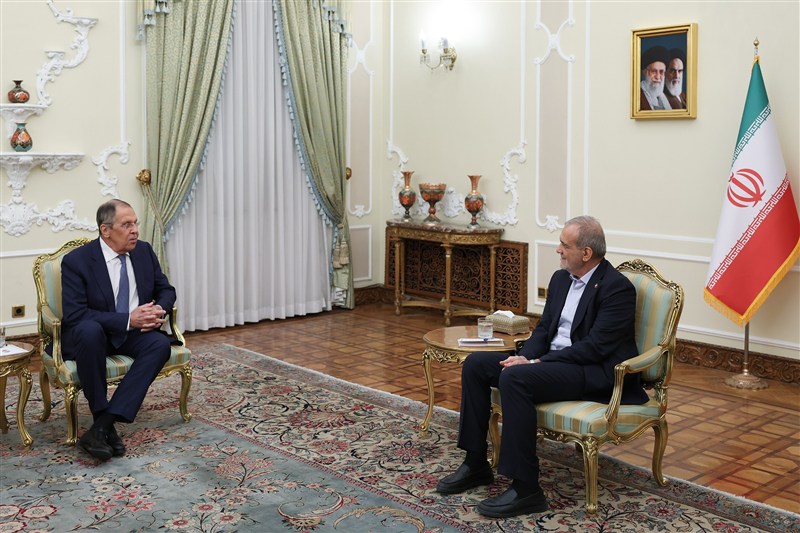
During a meeting with Russian Foreign Minister Sergey Lavrov in Tehran on Monday, Pezeshkian expressed satisfaction with the progress of bilateral relations and emphasized the importance of closer political and diplomatic coordination between the two countries.
The Iranian president referred to his recent meetings and telephone conversations with Russian President Vladimir Putin, noting that joint programmes were already underway. He expressed hope that his upcoming visit to Moscow would provide fresh momentum for implementing existing agreements and strengthening practical cooperation.
Pezeshkian also thanked the Russian government and people for their support during what he described as the recent war of aggression against Iran involving the United States and Israel. He stressed that continued mutual support remained important as both countries navigated an increasingly complex international environment.
A central focus of the discussions was the need to move beyond diplomatic commitments and establish clear timelines for cooperation. Pezeshkian highlighted existing agreements concerning the Caspian Sea and trade, calling for practical measures to advance projects in energy, transportation and power generation.
The talks also addressed regional security and international political developments. Pezeshkian condemned US and Israeli military actions against Iran, including attacks that he said resulted in the deaths of Supreme Leader Ayatollah Seyed Ali Khamenei, military commanders, scientists and schoolchildren, as well as damage to infrastructure. He argued that the actions violated international law and occurred while Iran was pursuing dialogue and diplomatic engagement. These allegations and characterisations reflect the Iranian president’s stated position.
Pezeshkian reiterated Iran’s opposition to any country imposing its political will on others through coercion. He called for an international order founded on mutual respect, national sovereignty, constructive cooperation and multilateralism, adding that Tehran and Moscow shared common ground on these principles.
Regional diplomacy was another important theme. Pezeshkian emphasised the importance of stronger relations among neighbouring countries and Muslim-majority nations, expressing Iran’s readiness to address regional disputes through dialogue and regional mechanisms. He also argued that the presence of US military bases in the region contributes to tensions and insecurity.
At the same time, the Iranian president expressed willingness to pursue joint initiatives with regional countries across several fields, including peace and security, economic development, culture, science and people-to-people exchanges. Such cooperation, he suggested, could help create stronger regional connections and provide alternatives to confrontation.
Pezeshkian identified BRICS, the Shanghai Cooperation Organization (SCO) and the Eurasian Economic Union (EAEU) as important platforms for expanding cooperation between Iran and Russia. These groupings could provide opportunities to strengthen trade, improve transport links, develop transit infrastructure and broaden economic engagement with other participating countries.
Lavrov, for his part, briefed Pezeshkian on his discussions with senior Iranian officials, saying the meetings had covered political, economic, commercial and cultural relations. He similarly stressed the need to accelerate the implementation of existing agreements rather than allow commitments to remain on paper.
The Russian foreign minister identified oil and gas, transportation, energy, communications, media, cultural exchanges, and scientific and academic cooperation as priority areas for further collaboration. He also highlighted the importance of continued diplomatic consultations and shared positions on international issues to support peace and security.
On the Caspian Sea, Lavrov called for closer coordination to protect the interests of both countries and strengthen regional stability. The issue reflects the wider strategic importance of cooperation between the two neighbours, whose relationship encompasses energy, trade, transport and regional diplomacy.
The meeting underscores Tehran and Moscow’s intention to deepen their partnership at a time of heightened geopolitical tensions and continuing efforts to strengthen economic links beyond traditional Western channels. However, the long-term impact of these discussions will depend on how quickly both governments translate their commitments into functioning projects, stronger trade flows and measurable economic outcomes.
For businesses and communities, the significance of closer Iran-Russia ties will ultimately be judged by practical results: more reliable transport connections, new commercial opportunities, stronger energy cooperation and tangible benefits from regional partnerships. Diplomatic statements can establish the direction, but consistent implementation will determine whether that ambition becomes a lasting reality.