


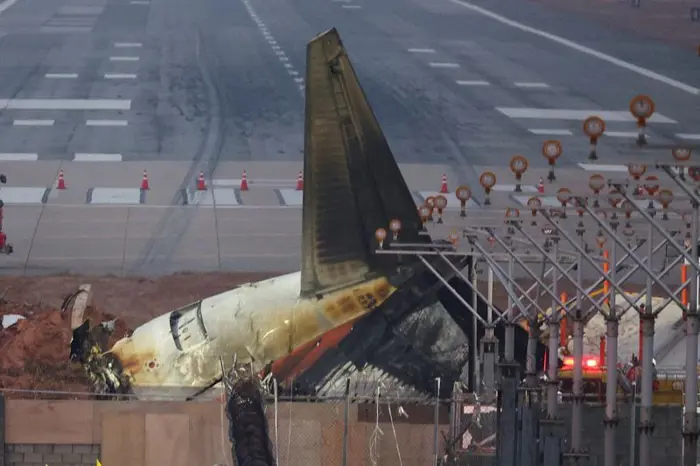
Jeju Air Crash Could Have Been Avoided: Lawmaker Highlights Fatal Runway Barrier
A South Korean government report has revealed a devastating truth about the December 2024 Jeju Air crash: the 179 lives lost might have been spared if a concrete barrier had not been in the way.
The Boeing 737-800, traveling from Bangkok, belly-landed and overran the runway at Muan International Airport. Almost everyone on board died after the plane struck a concrete support for a navigation antenna, with only two flight attendants at the far rear surviving.
Kim Eun-hye, a member of a bipartisan parliamentary committee examining the accident, said a government-commissioned simulation found that without the concrete mound—which failed to meet international safety standards—everyone on board could have survived. The report, carried out by a South Korean structural engineering institute, suggested the plane’s initial impact with the runway was unlikely to cause severe injuries. It indicated the aircraft could have slid over 770 meters (2,526 feet) to a safe stop if the barrier had not been there.
Further analysis suggested that had the navigation equipment been mounted on a breakable structure instead of solid concrete, the aircraft might have only breached a fence, resulting in minor injuries rather than a mass fatality.
Kim’s office did not release the full report, and Korea Airports Corp, which operates Muan Airport, said it could not comment until the final investigation is completed. South Korea’s Aviation and Railway Accident Investigation Board also did not respond immediately to requests for comment.
Families Demand Accountability
The lawmaker described the crash as the result of long-standing government negligence. The concrete structure had been built in 1999, repeatedly flagged as unsafe, but left uncorrected. Families of the victims, along with opposition politicians, are pressing for answers, accusing authorities of withholding critical information and delaying the analysis.
While the report sheds light on the runway structure as a hazard, it does not yet provide a final official conclusion on the crash. A comprehensive investigative report is still awaited after authorities missed a one-year deadline to release progress findings. The airport remains closed and is not expected to reopen until April.
A representative of the victims’ family association told Reuters, “This report is solid proof that the disaster was man-made.” Families are now demanding an apology from the investigation board for hiding these critical details.
Earlier updates from the investigation noted that both engines had suffered bird strikes. Investigators also found that pilots shut off the less-damaged engine after the strikes, but some of these findings were withheld from the public due to objections from victims’ families.
Meanwhile, South Korea’s parliament has opened its own inquiry into the crash, underlining growing calls for transparency and accountability in the wake of the tragedy.
This disaster is a stark reminder of the cost of neglected safety regulations, and the families’ quest for truth highlights the human impact behind the headlines.