


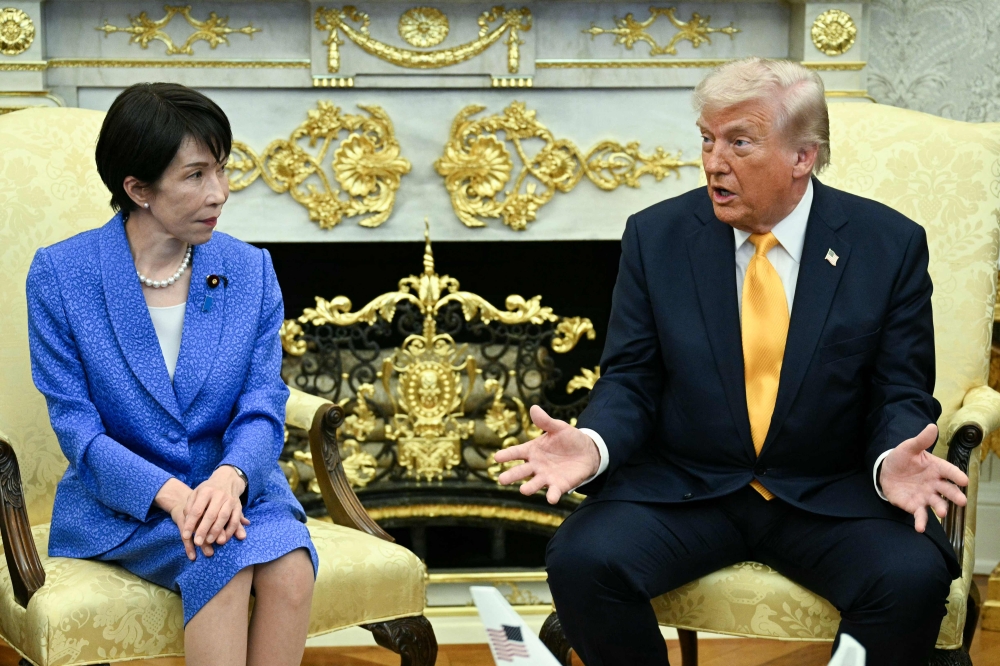
Japan PM Navigates Trump Meeting Smoothly Despite Pearl Harbor Remark
Japanese Prime Minister Sanae Takaichi managed to steer a delicate diplomatic meeting with Donald Trump without letting tensions derail the conversation, even after an unexpected historical reference to Pearl Harbor stirred the room.
The meeting took place in the Oval Office at the White House, where the two leaders discussed global security, energy stability, and the ongoing tensions surrounding the Strait of Hormuz. Despite recent criticism from Trump toward U.S. allies for not doing enough to help protect the critical oil route, the tone of this meeting appeared noticeably calmer.
Just days earlier, Trump had publicly criticized several allies, including Japan, for not responding strongly enough to his calls to support efforts aimed at reopening the Strait of Hormuz, a crucial waterway through which roughly one-fifth of the world’s oil supply travels.
However, during the meeting with Takaichi, the U.S. president shifted his tone.
Speaking to reporters, Trump acknowledged Japan’s role in addressing Middle East tensions.
“I believe that based on statements given to us yesterday and the day before yesterday regarding Japan, they are really stepping up to the plate,” Trump said.
After a brief pause, he added another comment that reflected his ongoing frustrations with other allies.
“Unlike NATO,” Trump remarked, repeating his familiar criticism of the U.S.-led military alliance primarily made up of European nations.
While Trump did not provide details about what role Japan might take in securing the Strait of Hormuz, his comments suggested a level of approval toward Tokyo’s willingness to participate in international efforts.
He also appeared warm toward Takaichi personally.
“I’m very proud of you. We’ve become friends,” Trump said, referring to Japan’s first female prime minister, who secured a landslide election victory earlier this year.
Footage released by one of Trump’s aides showed Takaichi greeting the U.S. president with a friendly embrace as she arrived at the White House, signaling a cordial atmosphere before discussions began.
Japan’s Delicate Position
For Japan, participation in overseas security operations is a politically sensitive issue.
The country’s Self-Defense Forces operate under a pacifist constitution adopted in 1947 after World War II, which formally renounces war as a means of resolving international disputes. Many Japanese citizens strongly support maintaining this principle.
Despite these domestic sensitivities, Japan joined five allied nations, including Britain and France, in announcing their readiness to contribute to efforts aimed at ensuring safe navigation through the Strait of Hormuz.
The announcement came just over an hour before Takaichi’s meeting with Trump.
Trump emphasized that it would be reasonable for Japan and other allies to assist in securing the waterway, particularly given how heavily Japan depends on it for energy imports.
Japan receives approximately 90 percent of its oil supplies through the Strait of Hormuz, making stability in the region critically important for its economy.
A Moment of Tension
While the meeting appeared smooth overall, an unexpected moment occurred when Trump referenced the historic attack on Pearl Harbor.
When a Japanese journalist asked why allies had not been included in discussions prior to the U.S. strikes on Iran, Trump responded with a remark that briefly shifted the tone.
“Who knows better about surprise than Japan? Why didn’t you tell me about Pearl Harbor?” he said.
The comment referred to Japan’s surprise attack on the U.S. Pacific Fleet in Hawaii on December 7, 1941, an event that brought the United States into World War II.
Observers noted that Takaichi leaned slightly back in her chair and appeared momentarily surprised by the reference.
Still, she remained composed and continued the meeting without escalating the moment, demonstrating a careful diplomatic approach.
Strategic Agreements and Investments
Despite the awkward remark, the meeting produced significant economic announcements.
The United States and Japan revealed plans for a $40 billion joint project aimed at constructing nuclear reactors in Tennessee and Alabama.
In addition, Japan committed $33 billion toward developing natural gas power generation facilities in Pennsylvania and Texas.
These investments build on a larger agreement reached last year in which Japan pledged $550 billion in investments in the United States through 2029.
In return, Washington agreed to reduce previously threatened tariffs on Japanese goods from 25 percent to 15 percent.
The deals reflect a deep economic partnership between the two nations, as well as Japan’s strategy of strengthening ties with Washington.
Security Ties Remain Crucial
Beyond trade and energy, Japan’s relationship with the United States remains central to its national security.
For decades, the United States has maintained a military presence in Japan, with around 60,000 American troops stationed across the country.
This security partnership plays a critical role in maintaining stability in the Asia-Pacific region, particularly as China continues to expand its influence and military presence.
Maintaining strong ties with Washington is therefore a strategic priority for Tokyo.
Challenges at Home
While Takaichi appears to be strengthening international partnerships, political pressure is growing domestically.
Recent opinion polls suggest that the strong public support she enjoyed following her election victory may be beginning to weaken.
One reason is rising energy costs.
The conflict involving Iran has pushed oil and gas prices higher, raising concerns among Japanese businesses and households about increased living costs.
As Japan relies heavily on imported energy, instability in global energy markets can quickly translate into economic strain for families and companies.
For Takaichi, balancing international commitments while protecting domestic economic stability will likely remain one of her biggest political challenges.
A Test of Modern Diplomacy
The meeting between Takaichi and Trump illustrates how modern diplomacy often unfolds in unpredictable ways.
Unexpected remarks, historical sensitivities, and geopolitical tensions can all emerge within a single conversation between world leaders.
Yet diplomacy is often defined not by avoiding difficult moments, but by how leaders manage them.
Takaichi’s calm response and focus on broader cooperation helped keep discussions centered on energy security, trade, and strategic partnerships.
In a world shaped by fragile alliances, economic uncertainty, and shifting power dynamics, moments like these reveal the importance of steady leadership and thoughtful dialogue.
Even when history enters the room unexpectedly, diplomacy still requires patience, composure, and the ability to move forward.