


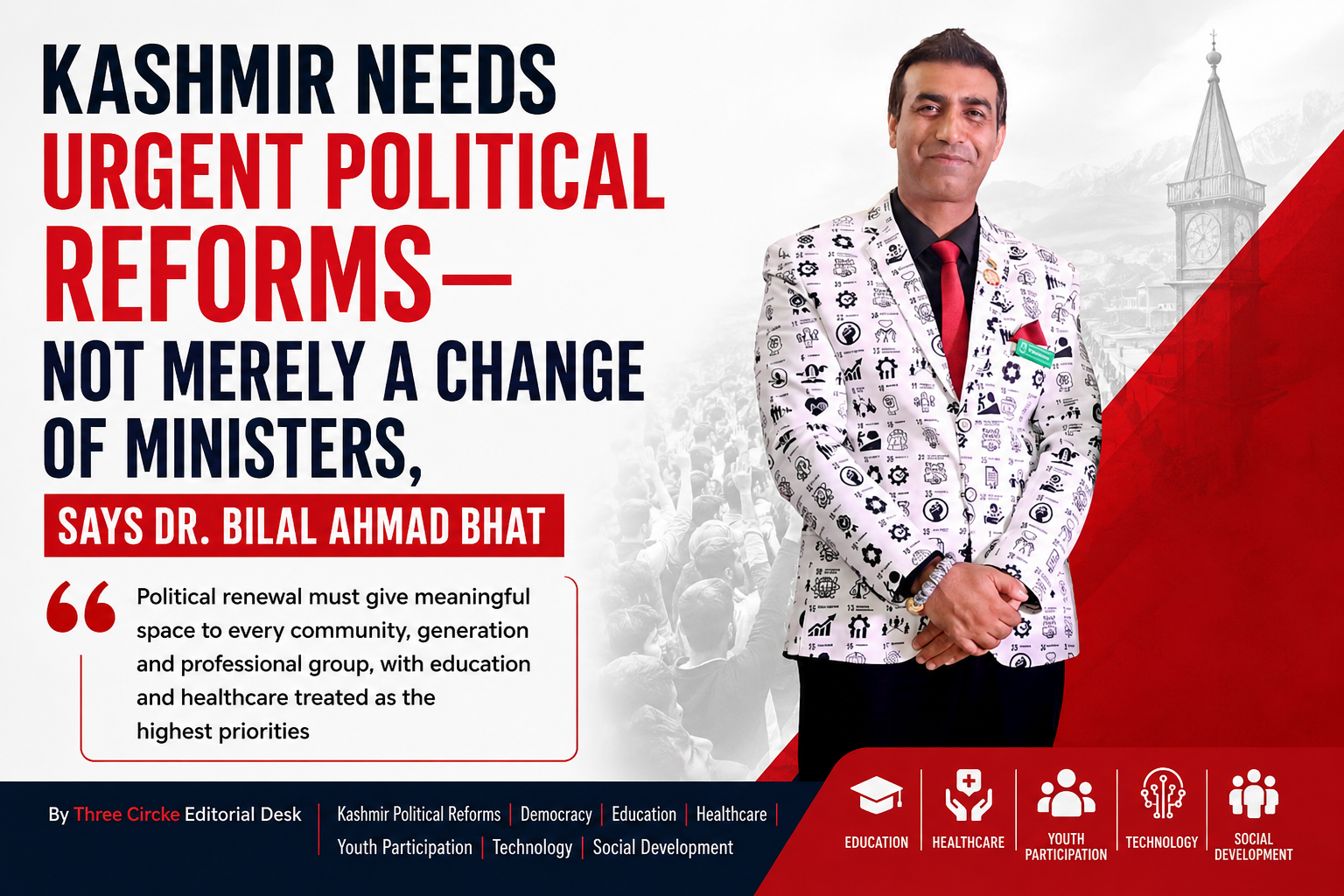
Kashmir Needs Urgent Political Reforms—Not Merely a Change of Ministers, Says Dr. Bilal Ahmad Bhat
Political renewal must give meaningful space to every community, generation and professional group, with education and healthcare treated as the highest priorities
By Three Circle Editorial Desk | Kashmir Political Reforms | Democracy | Education | Healthcare | Youth Participation | Technology | Social Development
Kashmir urgently needs comprehensive political and institutional reforms that extend far beyond changing a minister, replacing an officeholder or conducting another election, Dr. Bilal Ahmad Bhat has said.
Speaking through Zoom to representatives of several digital media channels, Dr. Bhat called for an inclusive reform process involving citizens from every part of society—including scholars, educators, journalists, community representatives, political leaders, professionals, entrepreneurs, women, senior citizens and young people from Generation Alpha onward.
He argued that genuine political reform cannot be measured only through changes in leadership. It must be reflected in the quality of education, accessibility of healthcare, responsiveness of institutions, participation of citizens, openness of public debate and the ability of people to influence decisions that affect their lives.
According to Dr. Bhat, Kashmir requires a political culture in which people are not approached merely as voters during elections but recognised as permanent participants in democratic governance.
“Reform does not simply mean changing a minister or replacing one political face with another,” he said. “Real reform means giving space to every person and every section of society. It means listening to people, understanding their problems and executing solutions that can be measured.”
Elections Alone Cannot Define Democracy
Dr. Bhat said elections are an essential part of a democratic system, but democracy cannot begin and end at the ballot box.
He maintained that voting is only one component of a much larger democratic process involving public consultation, institutional accountability, freedom of expression, access to information, transparent decision-making and continuous engagement between citizens and those holding public responsibility.
“We live in a democratic country. An election cannot be treated as the completion of democracy,” he said. “Democracy must remain active before elections, during elections and after elections. People must have the right to participate, question, recommend, criticise and contribute.”
He called for stronger mechanisms through which citizens can communicate directly with public institutions. These could include regular community consultations, youth forums, public hearings, digital grievance platforms, policy discussions and local development meetings.
Such mechanisms, he said, should not exist merely as formalities. Citizen feedback should be documented, evaluated and connected to decisions, deadlines and measurable outcomes.
Every Section of Society Must Be Included
A central part of Dr. Bhat’s appeal was the need to widen political participation beyond traditional party structures and familiar circles of influence.
He said Kashmir’s reform process must include people from villages, towns and cities, as well as communities that may feel geographically, economically, politically or socially excluded. Farmers, artisans, traders, workers, teachers, healthcare professionals, students, researchers, journalists, entrepreneurs, persons with disabilities and civil-society representatives should all be given opportunities to contribute.
“No society can reform itself by listening only to a small group,” Dr. Bhat said. “Every community carries experience and knowledge. Every generation understands a different part of the problem. If we want workable reforms, we have to bring these perspectives together.”
Kashmir’s cultural diversity, he added, should be treated as a collective strength. Different traditions, foods, languages, local identities and ways of life should not become reasons for separation or unequal attention.
“All communities have to move together,” he said. “Our diversity should guide us toward inclusion, respect and shared development.”
From Generation Alpha to Senior Citizens
Dr. Bhat placed particular emphasis on intergenerational participation, saying that political and social reforms must take account of both inherited experience and emerging realities.
Senior citizens possess valuable knowledge of Kashmir’s institutional, social and economic history. Middle-aged professionals understand the pressures facing families, workplaces and businesses. Young adults and students experience the challenges of education, employment, technology and global competition. Children belonging to Generation Alpha are growing up in a digital environment that will reshape learning, communication and civic participation.
“Every age group must have a place in the reform conversation,” he said. “Senior citizens should be heard for their experience, while younger generations must be included because they will live longest with the consequences of the decisions being made today.”
He suggested establishing structured youth councils, student policy forums and intergenerational advisory groups at local and regional levels. These platforms could enable young people to identify problems, develop proposals and engage directly with administrators, educators, public representatives and community leaders.
Education Reform Must Be the Highest Priority
Dr. Bhat identified education as one of the two most urgent areas requiring reform in Kashmir.
He said education policy must move beyond examinations, certificates and degrees. Schools, colleges, universities and vocational institutions must prepare students for employment, entrepreneurship, civic participation, technological change and responsible leadership.
Reform, he argued, should address teaching quality, school infrastructure, digital access, career counselling, research opportunities, teacher training, vocational education, industry partnerships and the gap between academic qualifications and labour-market requirements.
“Education must create capable, confident and responsible citizens,” he said. “It should help young people think independently, understand their society, develop practical skills and participate constructively in public life.”
He called for greater investment in rural and underserved educational institutions so that opportunity is not determined by location, income or family background.
Students should also receive exposure to entrepreneurship, financial literacy, digital skills, artificial intelligence, communication, environmental responsibility, constitutional values and community service.
Dr. Bhat said educators and scholars must play a direct role in designing reforms. Teachers interact daily with students and understand many of the pressures confronting young people. Their experience should therefore inform educational policy rather than being consulted only after major decisions have already been made.
Healthcare Reform Is Equally Urgent
Healthcare was identified as the second immediate priority.
Dr. Bhat said access to timely, affordable and reliable healthcare should be treated as a fundamental measure of effective governance. Reform should strengthen primary healthcare, district hospitals, emergency services, maternal and child healthcare, mental-health support, preventive medicine, diagnostic facilities and access to specialist care.
He stressed that people living in remote and rural areas should not be forced to travel excessive distances for essential treatment.
Healthcare reform should also include stronger public-awareness campaigns concerning nutrition, sanitation, preventive check-ups, mental wellbeing, addiction, lifestyle-related illness and early detection of disease.
Technology could help improve access through telemedicine, electronic health records, appointment systems, remote consultations and better coordination between local centres and specialist hospitals. However, Dr. Bhat cautioned that technology must support human care rather than become a substitute for adequate staffing, medicine, infrastructure and accountability.
“A reform is meaningful only when people can feel its effect in their daily lives,” he said. “If a family can access a doctor more quickly, if a patient receives treatment without unnecessary delay, or if a village gains reliable healthcare services, that is a measurable reform.”
Educated Youth Must Take Part
Dr. Bhat called upon Kashmir’s educated youth to become active contributors to political, social and institutional reform.
He said young people should not limit their participation to online criticism or election-time discussion. They should study public problems, understand policy, organise constructive initiatives, engage with local institutions and propose practical solutions.
Educated youth can contribute through research, data analysis, public-awareness programmes, entrepreneurship, social innovation, journalism, volunteering and responsible political participation.
“Young people must not wait for someone else to reform the system,” Dr. Bhat said. “They must enter the process with preparation, knowledge and a commitment to public service.”
At the same time, he said institutions must create credible space for young people. Asking youth to participate without giving them access, responsibility or decision-making opportunities would not produce meaningful change.
Young citizens should be represented in development committees, advisory bodies, educational boards, community projects and policy consultations. Their participation should be based on capability and commitment rather than family connections or political patronage.
Journalists and Digital Media Have an Important Role
While addressing digital media representatives, Dr. Bhat highlighted the responsibility of journalists and independent media platforms in expanding democratic participation.
He said journalism should provide space for diverse opinions, investigate public problems, verify claims and help citizens understand how policies affect their lives. Digital platforms can carry local issues beyond geographical boundaries, but they must act responsibly and avoid misinformation, sensationalism and social division.
Journalists, he added, should be able to ask difficult questions without fear or pressure. A healthy democracy requires space for criticism, disagreement and peaceful expression.
Dr. Bhat alleged that some voices have felt suppressed or excluded from democratic discussion. He maintained that every citizen should have the right to express a lawful opinion, communicate grievances and advocate change through peaceful and constitutional means.
“When voices are not heard, frustration grows,” he said. “Democracy becomes stronger when people are allowed to speak, when institutions listen and when disagreements are addressed through dialogue.”
He emphasised that freedom of expression must be accompanied by responsibility, respect for facts and a rejection of hatred or violence.
Reforms Must Produce Measurable Results
Dr. Bhat repeatedly stressed that reform should be judged by outcomes rather than announcements.
Government departments and public institutions, he said, should establish clear targets, implementation schedules and transparent performance indicators. Citizens should be able to see what was promised, what resources were allocated, what work was completed and what remains unfinished.
Education reforms could be measured through attendance, learning outcomes, teacher availability, digital access, vocational placements and student progression. Healthcare reforms could be evaluated through staffing levels, waiting times, medicine availability, patient outcomes and service coverage.
Employment programmes should disclose how many sustainable jobs were created rather than reporting only the number of registrations, training sessions or official events.
“The measures must count,” Dr. Bhat said. “People need to see results. Announcements without implementation cannot be called reform.”
He advocated independent evaluation, public dashboards and periodic progress reports that ordinary citizens can understand.
Technology Should Connect Citizens and Institutions
Technology, according to Dr. Bhat, can become a major instrument of transparent and participatory reform.
Digital platforms could be used to conduct consultations, collect public suggestions, register grievances, monitor development projects and publish institutional performance. Mobile-based systems could make these services accessible even to citizens unable to visit government offices.
Data could help identify shortages in schools, hospitals, employment programmes, transport systems and community infrastructure. It could also help authorities allocate resources according to evidence rather than influence.
However, he warned that digital reform must remain inclusive. Citizens without smartphones, reliable internet access or digital literacy should not be excluded from essential services. Online systems must therefore operate alongside accessible physical mechanisms.
Technology must also be supported by privacy safeguards, cybersecurity, data accuracy and clear accountability.
Awareness Must Reach Every Home
Dr. Bhat said reform cannot succeed without broad public awareness.
Citizens must understand their rights, duties and available institutional channels. They should know how to access government programmes, submit grievances, participate in consultations and hold representatives accountable through democratic and lawful means.
Awareness campaigns should use schools, colleges, community organisations, local-language media, digital platforms and village-level meetings. Information should be communicated in languages and formats that different communities and age groups can easily understand.
He urged educators, religious and community figures, journalists, professionals and social organisations to help spread accurate information and promote constructive civic engagement.
Reform Must Begin at Home
Concluding his remarks, Dr. Bhat said the responsibility for reform cannot be placed entirely upon politicians or government institutions.
Political reform must be accompanied by social and personal reform. Families should encourage education, equality, civic responsibility, honest work, respectful disagreement and service to the community.
“Reforms are urgent, but they must begin in every home,” he said. “We cannot demand accountability from institutions while ignoring responsibility in our own conduct. A stronger Kashmir will be built by responsible families, informed citizens, ethical leadership and institutions that listen.”
He called on citizens to reject indifference and recognise that every person has a role in strengthening society. Voting, he said, remains important, but citizenship also involves staying informed, helping communities, raising issues peacefully, respecting diversity and contributing to solutions.
A Call for an Inclusive Reform Framework
Dr. Bhat’s broader message was that Kashmir requires a continuing reform framework rather than a single political event.
Such a framework would bring together public representatives, administrators, scholars, teachers, healthcare workers, journalists, entrepreneurs, young people, women, community organisations and citizens from different cultural and linguistic backgrounds.
Its immediate priorities would be education and healthcare, followed by employment, institutional accountability, public participation, technology access and community development.
“Changing individuals without changing systems will not be enough,” Dr. Bhat said. “Kashmir needs reforms that listen to everyone, include everyone and produce results for everyone.”
His appeal ultimately placed responsibility on both institutions and citizens: public authorities must create space for participation and deliver measurable outcomes, while citizens must engage constructively, remain informed and begin the process of reform within their own families and communities.
For Kashmir, he argued, political renewal should not be understood merely as a competition for office. It should be a collective effort to build responsive institutions, educated communities, accessible healthcare and a democratic culture in which every lawful voice has an opportunity to be heard.