


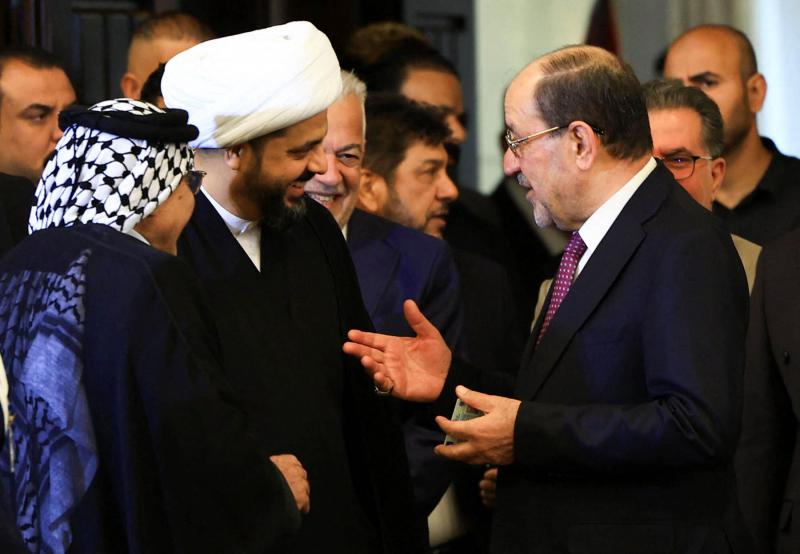
US Pushback Looms as Iraq Moves Toward New Government Under Nouri al Maliki
Iraq’s political landscape has entered a tense new phase after the Coordination Framework, the country’s largest parliamentary bloc, announced the nomination of former prime minister Nouri al Maliki as its candidate to lead the next government. The decision, revealed on Saturday, is already drawing scrutiny from Washington and is expected to complicate the delicate process of government formation.
The nomination follows the recent withdrawal of caretaker Prime Minister Mohammed Shia al Sudani from the race. Although his bloc emerged with the largest share of seats in the November parliamentary elections, internal competition within the Coordination Framework ultimately tipped the balance in favor of al Maliki after a series of leadership discussions and a majority vote.
According to a statement carried by the Iraqi News Agency, the Coordination Framework said the decision was reached after extensive consultations focused on current political conditions and the next stage of the country’s political process. The bloc cited al Maliki’s long experience in governance and his previous role in managing state affairs as key reasons for its choice.
Under Iraq’s constitution, the path forward requires parliament to first elect a president, who will then appoint a prime minister responsible for forming a cabinet. The Coordination Framework urged the Council of Representatives to convene promptly, stressing that adherence to constitutional timelines is essential to complete the remaining steps toward a new government.
Al Maliki previously served as prime minister from 2006 to 2014, a period marked by both consolidation of power and deep political controversy. While he remains a powerful figure within Shia politics, his earlier attempt to secure another term failed amid criticism that his leadership style centralized authority and strained relations with communities wary of Iran’s growing influence in Iraq.
Reactions to his nomination have been sharply divided. The Iraq National Political Council, which includes parties critical of Iran-aligned politics, called on the Coordination Framework to take what it described as a historic responsibility and warned against returning to leadership figures associated with past failures. In contrast, the influential Sunni Azm Alliance dismissed those concerns and openly backed al Maliki’s candidacy.
Whoever forms the next government will inherit mounting pressure from both the United States and Iran, particularly over the future of Hashd al Shabi, the powerful paramilitary force that played a major role in defeating the Islamic State group. Washington has repeatedly urged Baghdad to rein in or disarm the group, a demand complicated by Hashd’s political clout and Iran’s strong opposition to such moves.
Security concerns are further intensifying the debate. While Hashd al Shabi was instrumental in combating Daesh during its rapid expansion a decade ago, fears of a potential resurgence remain, especially amid ongoing instability in neighboring Syria. In this context, the US military recently confirmed it has begun transferring some of the roughly 9,000 Islamic State detainees held in northeast Syria to detention facilities inside Iraq.
At the same time, reports have emerged of increased US pressure on Iraqi leaders regarding the composition of the next cabinet. Reuters, citing multiple sources, reported that Washington has warned of possible financial sanctions if certain political factions are included in the government. These measures could extend to restricting Iraq’s access to oil revenues, which are held in a Central Bank account at the Federal Reserve Bank of New York.
According to Iraqi officials, these warnings have been conveyed repeatedly over the past two months by US Chargé d’Affaires Joshua Harris to senior political figures, including Prime Minister al Sudani, prominent Shia leaders, and Kurdish officials. The message, sources say, was explicit: the inclusion of 58 MPs targeted by the United States could result in suspended diplomatic engagement and a halt to dollar transfers.
Such a move would mark a significant escalation. While individual Iraqi banks have faced US sanctions in the past, restricting dollar transfers linked to oil revenues would have far-reaching consequences for Iraq’s economy and governance.